
Beyond Production: Why African Agribusinesses Need Commercial Discipline to Scale
Africa presents one of the world’s largest agribusiness growth opportunities. The continent’s food and agriculture market is projected to reach USD 1 trillion by 2030, while agriculture remains a cornerstone of economic activity, contributing approximately 49% of employment in Sub-Saharan Africa and 17.9% of regional GDP[1]. These figures highlight not only the scale of the market opportunity but also the critical role that agribusiness plays in driving economic growth, employment, and food security. The key challenge for the private sector is therefore not whether the opportunity exists, but how agribusiness can successfully translate this production potential into commercially viable, resilient, and investment-ready enterprises capable of sustaining long-term growth.
Across the continent, many agribusinesses already have the foundations to grow, with producers expanding, processors adding value, and exporters reaching new markets. However, growth is often limited by weak commercial systems. Even with strong assets and demand, businesses can struggle to scale if margins are unclear, cash flow is poorly managed, or operations lack structure and consistency.
In these cases, the issue is not simply whether the business can produce. It is whether the business is commercially structured to turn production capacity into performance.
As businesses grow, complexity increases, volumes rise, working capital needs to expand while supplier, customer and financing relationships become more demanding. Decisions that may have worked informally at a smaller scale begin to require stronger systems, controls and accountability.
Growth magnifies weak systems
Growth is often seen as the solution, but growth can also expose weaknesses that were previously hidden.
If a business does not understand its true cost of production, higher volumes can increase losses rather than improve profitability. If cash flow is not properly managed, growth can create pressure on suppliers, staff, inventory and debt repayment. If reporting is weak, management may not see problems early enough to respond. If roles and decision rights are unclear, execution becomes slower as the business expands.
The African Development Bank has noted that Africa imports over 100 million metric tons of cereals annually, at a cost of about USD 75 billion. This points to the need for stronger and more competitive agricultural value chains, not only increased production.[2]
What commercial discipline really means
Commercial discipline is the ability to run a business with clarity, control and accountability. It means the business is not only focused on producing more, but also on understanding how production translates into revenue, margins, cash flow and long-term value.
Commercial discipline is the foundation that enables businesses to make informed decisions, manage risk, attract investment and execute growth plans effectively.
Why this matters for investment and partnerships
Many agribusinesses need external capital to scale, whether through debt, equity, grants, strategic partnerships or buyer relationships. But capital providers do not only assess the size of the opportunity. They assess the ability of the business to execute.
Investors want to understand the growth story, but they also want to see the numbers behind it. Lenders want confidence in cash flow and repayment capacity. Strategic partners want to know that the business is reliable, well managed and able to deliver. Buyers want consistency in quality, volumes and service.
This is especially important given the scale of the financing challenge. About 70% of micro, small and medium-sized enterprises in emerging markets lack adequate financing to thrive and grow, with the formal MSME finance gap estimated at USD 5.2 trillion.[3]
Businesses that can show clear strategy, credible financial information, disciplined operations, strong governance and a defined route to market are better positioned to attract capital, secure partnerships and grow sustainably.
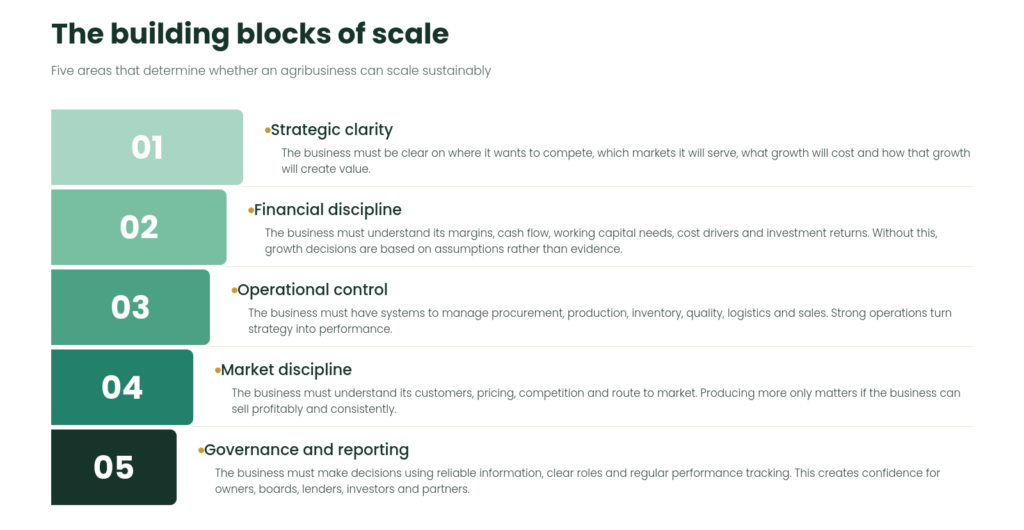
Together, these elements create the foundation for sustainable growth and long-term competitiveness.
Conclusion
Africa’s agribusiness opportunity is significant but capturing it takes more than strong production. It takes commercial foundations: clear strategy, financial discipline, operational control, market focus, and governance that holds it all together.
At Agri Frontier, we work with agribusinesses, investors, and institutions across the agricultural value chain to build exactly this – helping producers, processors, aggregators, and exporters clarify their strategy, understand their numbers, and prepare for funding, partnerships, or expansion.
If your business has the assets and the demand but growth still feels harder than it should be, that’s usually a commercial discipline problem, not a production one. Let’s talk.
[1] World bank. 2026. Estimate of the size of African’s food market by 2030.
[1] African Development Bank. Imports
[1] IFC, Formal MSME finance gap
← Back to Insights