
Derisking Investment Through Feasibility Studies
Risk and reward go hand in hand, and no investment is risk-free. Only when you understand the different types of risks that apply to various investments can you answer the question, ‘How much risk am I prepared to take?’
About 70–75% of venture-backed startups eventually fail, with most shutting down between their second and fifth year of operations. The leading cause is a lack of market need (42%), followed by running out of cash(29%). These statistics highlight the critical role of conducting comprehensive feasibility studies prior to launching or scaling a business. Such studies enable entrepreneurs and investors to evaluate market demand, test the financial viability of proposed business models, and assess operational readiness. By identifying potential gaps and risks early, feasibility studies provide a structured framework for informed decision-making, reducing the likelihood of costly missteps and improving the prospects of long-term success.
Role of Feasibility Studies in Derisking Investments
Feasibility studies play a key role in determining whether a business idea makes financial sense. They weigh expected costs against potential benefits to assess if the project is likely to deliver a positive return on investment. If the numbers don’t add up, the study highlights that the business may not be financially sustainable, helping investors or entrepreneurs avoid risky ventures.
Beyond assessing financial viability, feasibility studies also uncover new opportunities, such as improved marketing strategies and technical solutions for growth. They identify and outline the resources required, manpower, equipment, and materials so that investors can allocate them efficiently and avoid delays. By analyzing potential risks and opportunities in depth, feasibility studies make critical variables more predictable, increasing the likelihood of business success and enabling informed, confident decisions.
Key Components of a Feasibility Study
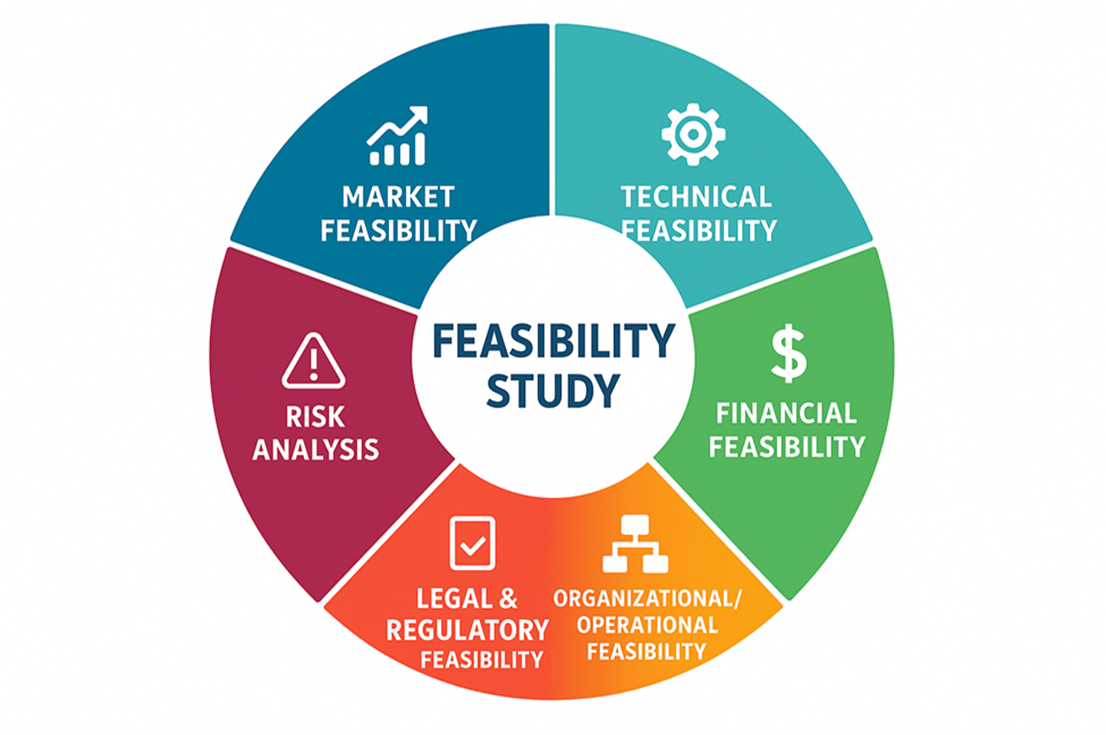
A well-rounded feasibility study goes beyond financial projections, testing a business idea’s viability from multiple angles. Core components of a feasibility study include:
- Market Analysis: Helps in understanding the market demand, competition, pricing trends and target customers.
- Technical Feasibility: Helps to assess production capacity and infrastructure, equipment, and technology needs.
- Financial Feasibility: This evaluates the projected revenues, costs, profitability and returns as well as potential financial risks.
- Legal and Regulatory Considerations: Helps in verifying that the project complies with the relevant laws, standards and policies to avoid future bottlenecks.
- Social and Environmental impact: This measures the impact of the project to the communities and how it aligns with sustainability and environmental goals.
- Organizational Capacity: Helps in reviewing whether a business venture has the right skills, governance structures and systems to implement and sustain the project.
- Risk assessment: Helps in identifying key financial, operational and external risks and effective mitigation in advance. Some of the different risks that are identified through feasibility studies include:
- Financial risk– Weak revenue strategies, poor forecasting, or ineffective financial management leading to flawed models and unpredictable cash flows.
- Regulatory risk– Non-compliance with relevant policies, laws, and licensing requirements can expose businesses to significant challenges, including financial penalties, operational disruptions, reputational damage, and costly legal proceedings.
- Operational risk– Arises from weaknesses in internal processes, human resources, and systems, as well as from unforeseen external events. Inefficiencies or gaps in these areas can lead to significant financial and operational losses. Moreover, unauthorized activities such as employees executing tasks beyond their mandate can result in fraud, theft, or deliberate sabotage, further undermining business continuity and performance. A robust feasibility study helps address these vulnerabilities early, enabling organizations to design stronger controls and risk management frameworks
Conclusion
A feasibility study is the foundation of sustainable agribusiness growth because investing wisely is investing confidently. By identifying potential financial, regulatory, and operational risks early, businesses and projects can avoid costly missteps, allocate resources efficiently, and secure stronger stakeholder buy-in.
At Agri Frontier, we go beyond simply assessing viability, we provide actionable insights that unlock opportunities, strengthen compliance, and chart a clear roadmap for successful execution. Whether you’re an established enterprise exploring expansion or an investor evaluating a new project, our team delivers the expertise and sector knowledge needed to guide your decisions with confidence.
Do not leave your success to chance. Partner with Agri Frontier to transform ideas into sustainable, profitable agribusiness ventures.
Author: Margaret Waithera
← Back to Insights