
Harnessing Renewable Energy in Africa: A Circular Approach
Harnessing Renewable Energy in Agriculture in Sub Saharan Africa: A Circular Approach
Sub-Saharan Africa faces significant challenges in achieving sustainable agricultural productivity, ranging from unreliable energy supplies and climate change to limited access to modern farming techniques. However, integrating renewable energy into agricultural practices offers a transformative solution that can address these issues while promoting environmental sustainability and economic resilience.
With over 80% of the region’s agricultural production coming from smallholder farmers, there is immense potential to harness renewable energy to power and transform the agricultural sector. By adopting a circular approach—where resources are reused and recycled within the agricultural system—Sub-Saharan Africa can enhance food security and foster sustainable development.
The Potential of Renewable Energy in Agriculture
Africa is endowed with abundant renewable energy resources, most of which remain untapped. Despite this wealth of natural resources capable of addressing the continent’s unmet energy needs, substantial challenges persist. Agriculture contributes over one-third of the gross national product (GNP) and employs more than two-thirds of the labour force, with about 70% of the population residing in rural areas. To harness the full potential of agriculture, it is imperative to link rural populations with off-grid energy sources, to boost agricultural productivity and ensure food security.
Renewable energy sources such as solar, wind, and bioenergy offer significant potential for agricultural applications in Sub-Saharan Africa. These energy solutions can power irrigation systems, cold storage facilities, and agro-processing units, thereby enhancing agricultural productivity and reducing post-harvest losses.
- Solar Energy: Traditional agricultural practices are often energy-intensive and heavily reliant on fossil fuels, resulting in high costs and environmental degradation. Solar energy offers a sustainable alternative with multiple applications in agriculture. Solar-powered irrigation systems provide a reliable water supply for crops, particularly in arid and semi-arid regions. Solar pumps can draw water from underground sources, making irrigation more sustainable, cost-effective, and environmentally friendly by reducing greenhouse gas emissions. Solar dryers can also be used to preserve agricultural produce by extending its shelf life and reducing post-harvest losses. Additionally, solar-powered cold storage facilities can be implemented to help maintain the quality of perishable goods, further minimizing waste and improving food security.
By integrating solar energy into agricultural practices, farmers can achieve greater efficiency, reduce costs, and contribute to environmental sustainability.
- Wind Energy: Wind energy is one of the most mature and cost-effective forms of renewable energy and has vast potential to revolutionize agriculture. Wind turbines can generate electricity to power farms and rural communities. Wind energy can also be integrated with solar systems to create hybrid power solutions, ensuring a consistent energy supply regardless of weather conditions.
- Bioenergy: Agricultural waste can be converted into bioenergy through anaerobic digestion, producing biogas and organic fertilizers. This not only provides a renewable source of energy for farm operations but also improves soil health and fertility.
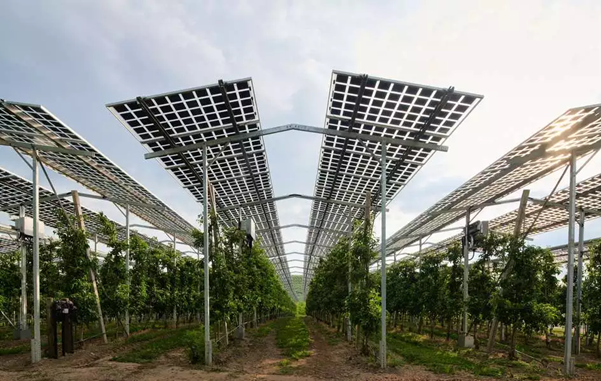
A Circular Approach to Renewable Energy and Agriculture
According to a 2023 report by the United Nations Environment Programme (UNEP), the circular economy (CE) and sustainable resource management focus on ensuring that resources are managed in a way that benefits future generations. This involves preventing the depletion of natural resources and maximizing the use-potential of products through reuse, recycling, and refurbishment to extract maximum value. This sustainable approach is gaining global traction as a means to address resource scarcity, environmental degradation, and economic inefficiencies. Implementation of this approach can be achieved through the following strategies:
- Renewable Energy for Agriculture: Invest in decentralized renewable energy solutions, such as solar mini-grids and biogas plants, to power agricultural activities and processing. Utilizing renewable energy reduces dependency on fossil fuels and lowers greenhouse gas emissions.
- Agricultural Waste to Energy: Utilize agricultural waste and residues to generate bioenergy, which can then be used to power farming operations, creating a closed-loop system.
- Sustainable Agricultural Practices: Promote climate-smart agriculture techniques, such as agroforestry, aquaponics, vertical farming and conservation tillage, to enhance soil health, sequester carbon, maximise resource utilisation and improve the sustainability of the agricultural system.
- Enabling Policies and Financing: Develop supportive policies, regulations, and financing mechanisms to incentivize the adoption of renewable energy and sustainable agricultural practices.
Unlocking the Potential: Partnerships and Innovations
Realizing this circular approach will require collaboration among various stakeholders, including governments, the private sector, development partners, and local communities. Key actions include:
- Fostering public-private partnerships to scale up renewable energy and agricultural investments.
- Supporting research and development of innovative technologies, such as solar-powered irrigation and biogas-based processing.
- Strengthening capacity-building and knowledge-sharing initiatives to empower smallholder farmers.
- Ensuring equitable access to renewable energy and sustainable agricultural practices, especially for marginalized communities.
Harnessing renewable energy in agriculture through a circular approach offers a pathway to sustainable development in Sub-Saharan Africa. By integrating renewable energy technologies and promoting resource efficiency, the region can enhance agricultural productivity, mitigate climate change impacts, and improve the livelihoods of millions of smallholder farmers. Policymakers, development agencies, and private sector stakeholders must collaborate to scale up these initiatives, ensuring that the benefits of renewable energy reach every corner of Sub-Saharan Africa.
By Annabell Okendo, Senior Agribusiness Financial Consultant
References
https://climateanalytics.org/press-releases/renewable-energy-transition-in-sub-saharan-africa
https://sustainenvironres.biomedcentral.com/articles/10.1186/s42834-023-00193-8
https://www.worldbank.org/en/programs/energizing-africa/overview
Image credit: SunCulture (The SunCulture solar-powered irrigation pump.)
← Back to Insights