
Investing in women to accelerate progress from the farm to the boardroom
By Wandia Musyimi, Senior Executive Recruitment Consultant
March is widely considered Women’s History Month and we reflect on this year’s International Women’s Day theme “Invest in Women: Accelerate Progress”. The theme has been a clarion call for investment in women in a way that the others this past decade have not. In it, investment into women, and humanity’s overall advancement are made inextricable.
While this is a bold connection, it is understandable. The current global economic downturn, political instability and conflict, climate disasters, Covid-19 and other significant macroeconomic factors have meant that spending outside of essential services and social protections has been decreased by governments and private sector organisations alike. Historically, such changes have disproportionately and negatively impacted women and girls. In the agrifood industry alone, 22% of women in the off-farm segment lost their jobs the first year of the pandemic in comparison to 2% of men.[1] Additionally, it is predicted that close to 1 in 4 women and girls will be moderately or severely food insecure by 2030.[2]
The merits of eliminating gender–based obstacles and the benefits for the wider society have long been addressed, and despite this, norms and rules that constrain women still exist.
We lend our focus at Agri Frontier to the agricultural sector in emerging markets and the role of players in the sector in advancing progress, whether that be through conducting living wage benchmark assessments for farm workers in Sub-Saharan Africa to in-depth feasibility studies on establishing large scale agricultural operations, and even gender and climate focused studies.
We recognise the immense potential of investing in women to drive progress across all facets of agriculture. Therefore, in this article, we delve into the transformative power of empowering women in agribusiness and the crucial role it plays in accelerating growth from the grassroots to the highest echelons of leadership.
Why invest?
In today’s agricultural landscape, there is an ever-growing recognition of women’s pivotal role. In some parts of the world, women constitute up to 50% of the agricultural workforce. In sub-Saharan Africa, roughly 66% of women are employed in agrifood systems, compared to 60% of men.
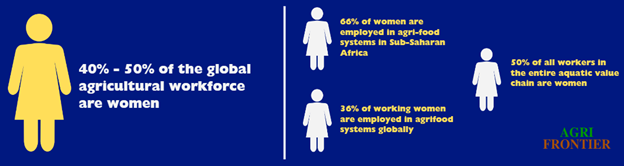
From tending to crops in the fields to making strategic decisions in the boardroom, women are driving innovation, sustainability, and growth across the agribusiness sector. However, to truly unlock the sector’s potential, it’s imperative to invest in women at every level.
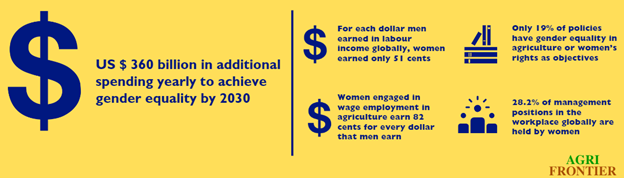
In order to achieve gender equality and women’s empowerment globally by 2030, an additional US $ 360 billion needs to be spent yearly. Furthermore, the disproportionate impact of the multiple ongoing crises on women and other marginalised groups means they remain at risk of food and job insecurity, poverty and discrimination. Worse still, while formal policies and strategies have increased in number, they mainly identify and recognise the constraints and inequalities that women face rather than specify objectives to address them. A study by the Food and Agriculture Organisation (FAO) covering 68 countries found that more than 75 percent of agricultural policies recognised women’s roles and/or challenges in agriculture, only 19 percent had gender equality in agriculture or women’s rights as explicit policy objectives.[3]
Beyond Tokenism: Fostering Genuine Equity
While simply increasing the number of women in the workforce is a positive step, true progress requires a commitment to genuine equity. This means creating an environment where women have equal opportunities to employment, advancement, recognition, and leadership roles. It involves addressing systemic barriers such as unconscious bias and unequal access to resources. By fostering a culture of equity, agribusinesses can foster a more inclusive and supportive workplace for all employees.
As it currently stands, just over 60% of prime working age women are in the labour force compared to just over 90% of prime working age men [4] – indicating a barrier to labour force entry, or reluctance to join the labour force by women. The reasons for this are layered and mainly cut across women’s socio-cultural responsibilities and their impact. And even when employed, women are significantly more likely than men to work part-time or in other vulnerable positions.
Systemic barriers related to gender pay gaps within the agricultural industry also exist. Recent studies show that for each dollar men earned in labour income globally women earned only 51 cents, and 82 cents for every dollar earned by men in agricultural labour.
Lastly, the data surrounding promotions and career advancement opportunities for women compared to their male counterparts is not promising. Women are more likely to experience gender-based discrimination in the workplace and this not only impacts organisational inclusivity culture, but also employee satisfaction and retention rates.
Let us now explore how we do this and the ways in which prioritising women’s empowerment can catalyse progress from the farm to the boardroom.
Investing in Women as a Catalyst for Workplace Diversity and Inclusion/ Progress catalyst
Diversity and inclusion are therefore not just buzzwords; they are fundamental pillars of a thriving workplace. By investing in women, agribusinesses can harness a diverse range of perspectives, experiences, and skills. This diversity enriches decision-making processes, fosters innovation, and enhances productivity. Moreover, it sends a powerful message that all voices are valued and respected within the organisation. An additional 58 million people’s incomes would be significantly increased, and an additional 235 million people will become more resilient as a result of development interventions that focus on empowering women.
So how can agribusinesses tap into these benefits?
- Inclusive Hiring Practices
- Recruitment Processes: Building a diverse workforce starts with inclusive hiring practices. Proactively seeking out qualified candidates and ensure that recruitment processes are fair and transparent. This may involve implementing blind resume screening, offering flexible work arrangements, and providing training on unconscious bias for hiring managers. By removing barriers to entry, organisations can attract top talent from diverse backgrounds and strengthen their teams.
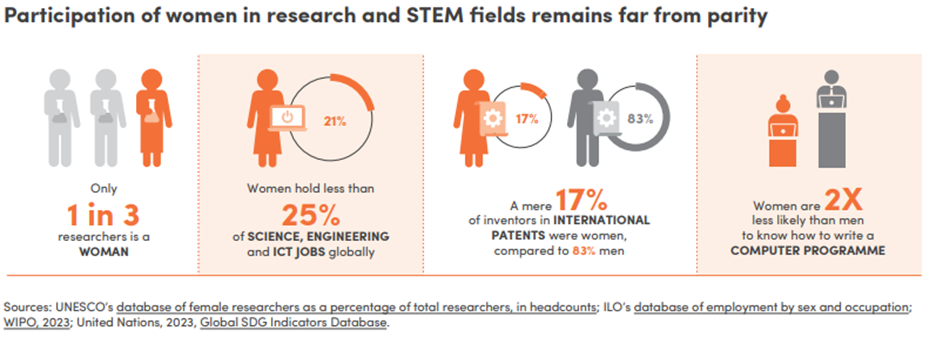
- Applications and Interviews: When thinking about agri–value chains that require more technically skilled individuals, especially in science, technology, engineering and mathematics (STEM). While a good number of organisations explicitly encourage applicants from diverse backgrounds (across gender, race, nationalities, disabilities) to apply from jobs, this practice needs to shift from a nice to have, to an essential component of job descriptions, calls for applications and all other expressions of interest. This practice should be reflected in how many women are shortlisted and interviewed.
- Conducive Work Environments and Practices
Challenges to women’s full and equal employment in the agricultural sector hold back their productivity and sustain wage gaps. Even with their contributions in various capacities, from planting and harvesting crops to managing livestock and overseeing farm operations, women are significantly more likely than men to hold vulnerable positions in workplaces, from their positions and working conditions to the compensation they receive. For example, women who work in agricultural production tend to be concentrated in the poorest countries and working in unfavourable conditions and generally women earn 18.4 percent less than men in wage employment in agriculture. The effects of this are exacerbated further down the value chain.
- Workplace Conditions: Workplace considerations that take into account the unique challenges that women face do not necessarily have to be in monetary form. Factoring into workplace policies and benefits the realities that women with children and women with domestic responsibilities have goes a long way in creating conducive work environments. From flexible working hours to crèches in corporate settings, to extended maternity leave and even lactation facilities are some ways in which this can be done.
- Compensation Practices & Career Advancement: The benefits of closing the gender gap in farm productivity and the wage gap in agrifood systems include increasing global gross domestic product by 1 percent (or nearly US $1 trillion). This would reduce global food insecurity by about 2 percentage points, reducing the number of food-insecurity people by 45 million. Embedding pay parity practices including equal pay for equal work, regardless of gender, organisations uphold fundamental principles of fairness but also drive tangible benefits for businesses and society at large. Pay parity practices not only attract and retain top talent but also enhance employee morale, productivity, and loyalty.
- Strategies for Advancing Women’s Leadership in the Workplace
To truly accelerate progress, agribusinesses must actively support the advancement of women into leadership roles. Progress in this regard has been made globally, women 28.2% of management positions in the workplace[5] and this number keeps edging close to the 1/3rd minimum gender rule of thumb figure.
- Women in Leadership Initiatives: This requires implementing targeted leadership development programs, mentoring initiatives, and networking opportunities specifically tailored to women in the workplace. Additionally, organisations should provide sponsorship and advocacy to ensure that women have access to high-profile projects and visibility within the company. Agribusinesses should also consider gender diversity in senior leadership by putting in place quotas as well as joint leadership initiatives. By nurturing the next generation of female leaders, agribusinesses can drive meaningful change and unlock new avenues for growth.
- Internal Policy and Structural Backing
In addressing these gaps, organisations should look to not just identify and recognise the challenges, but rather address them through tangible actions, behaviors and practices at an organisational level. From HR policies and manuals, gender equity declarations and contracts there should be a coherence in the messaging and behaviors related to driving gender equity within agribusinesses, with the culture being driven from the top.
Conclusion
Investing in women is not just the right thing to do; it’s also smart business. By prioritising diversity, equity, and inclusion, agribusinesses can harness the full potential of their workforce and drive innovation and growth. From the farm to the boardroom, women are integral to the future success of the agricultural industry, and it is always time to invest in their empowerment.
[1] Food and Agriculture Organisation, The status of women in agrifood systems, 2023
[2] Food and Agriculture Organisation, The status of women in agrifood systems, 2023
[3] From a sample size of 68 countries. UN Women, progress on the sustainable development goals: the gender snapshot 2023, 2023
[4] UN Women’s progress on the sustainable development goals: the gender snapshot 2023, 2023
[5] UN Women’s progress on the sustainable development goals: the gender snapshot 2023, 2023
← Back to Insights